Tips Up or Tips Down, Revisited
My son asked about bananas. Fourteen years later, I'm still answering.

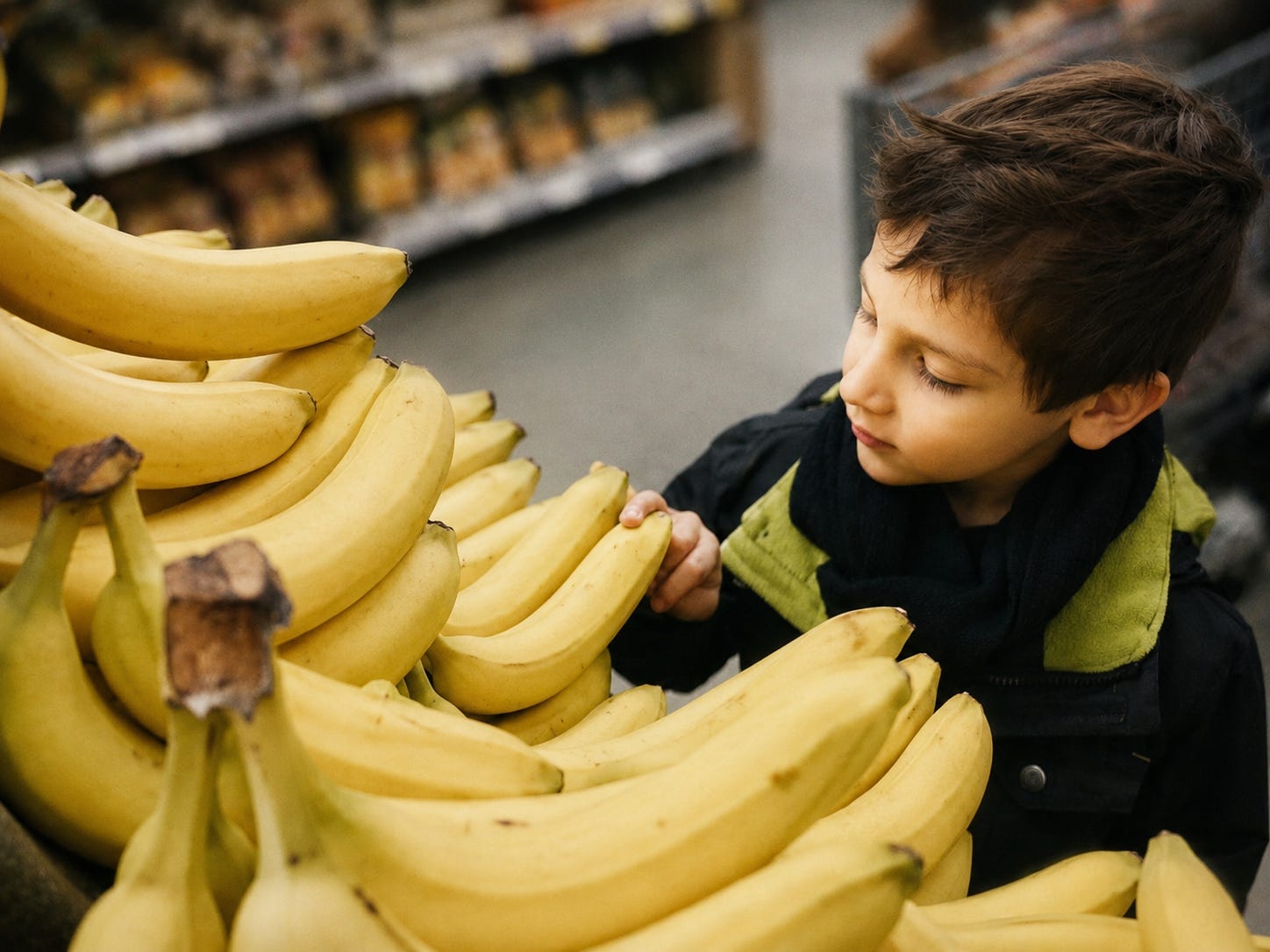
In October of 2012, I wrote a short post called Tips Up or Tips Down? It was about a trip to the grocery store with my five-year-old son. Standing in the fruit section, he asked me whether bananas grow with their tips up or their tips down. I didn’t know. So I did what connected dads did in 2012: I pulled out my iPhone, Googled it, and within thirty seconds we were looking at photos of banana plants.
“We no longer had to wonder,” I wrote. And then, catching myself: “I did that entirely wrong.”
The regret in that post wasn’t about the information. It was about the sequence. I could have asked him what he thought, and why he thought it. Instead, well, I’ll let my 2012 self say it, because he put it better than I remembered:
Instead of providing my boy with an extended opportunity to be curious, to imagine deeply and to think creatively, I reinforced one of the worst habits of our generation. I demonstrated to my boy that you can solve a problem without thinking. And, I won’t do that again.
That five-year-old is an adult now. And I’ve been thinking about that moment in the fruit aisle a lot lately, because the thing I was worried about in 2012 has grown up too.
What I got right
Rereading the post, I’m struck by how little of the core concern needs updating. The worry was never about Google specifically. It was about the collapse of the space between a question and its answer, and about what gets lost when that space disappears. Wondering, it turns out, is not a decorative phase of learning that we pass through on the way to the real thing. Wondering is the real thing. The guess, the reason for the guess, the argument with yourself about whether your reason holds: that’s where the learning lives. The answer is mostly just the moment the learning stops.
The comment section of that old post was, in the way of blog comments from that era, better than the post itself. Readers debated whether looking things up erodes memory, whether curiosity needs scarcity to survive, whether the right move was simply to hand my son the phone and let him do the searching. One commenter predicted that within five years we’d all be wearing Google Glass, and the banana tree would simply appear in my son’s peripheral vision before he’d finished forming the question.
The hardware prediction missed. The trajectory didn’t.
What I couldn’t have imagined
Here’s what’s different in 2026, and why I think that little post was more prescient than I understood at the time.
Google, for all my hand-wringing, still made you do something. It handed you a page of links, a pile of photos, a set of claims of varying quality, and left the assembly to you. The thirty seconds my son and I spent looking at banana plants involved looking, comparing, deciding which images to trust. It was a diminished form of inquiry, but it was still inquiry. The raw materials required a builder.
Generative AI removes the assembly. Ask a chatbot about bananas and you don’t get materials, you get a finished artifact: a fluent, confident, well-organized answer, delivered in the tone of someone who has never once been unsure of anything. There is nothing left to put together. And increasingly, there is nothing left to ask. The systems now suggest the follow-up questions too. They anticipate what you might wonder next and wonder it for you, politely, in a little row of tappable prompts.
In 2012, I worried that I had outsourced my son’s answer. The tools of 2026 are coming for the question itself.
That’s the shift that matters, and I don’t think we’ve fully absorbed it. A search engine was a reference tool with a fast index; it occupied roughly the same category as the encyclopedia and the dictionary that earlier commenters on that post remembered being steered toward as children. A conversational AI is not a reference tool. It’s a substitute interlocutor. It occupies the seat that used to belong to the other person in the conversation, the teacher, the parent in the fruit aisle. When I Googled the banana question, I skipped a conversation with my son. When a child asks a chatbot today, the skipped conversation is the product.
The part I have to confess
If you know my recent writing, you know I’m not building toward a call for abstinence. I use these tools daily, for real work, and much of that work is better for it. The honest confession, in the spirit of the original post, is that the 2012 version of my mistake is now something I commit several times before breakfast. The reflex I regretted at the grocery store, the reach for the device at the first flicker of not-knowing, has been sanded into something so smooth and frictionless that I often don’t register it as a choice at all. The opt-out still exists. It’s just very hard to find and even harder to press.
But the lesson from the fruit aisle scales up rather well, because it was never a lesson about technology. It was a lesson about sequence. Which do you think? Why do you think that? Those two questions cost nothing, require no policy, no filter, no ban, and they change everything about what happens next. They put the human guess before the machine answer. They protect the pause in which a five-year-old, or a fifty-year-old, does the irreplaceable work of having a thought of their own before someone, or something, hands them a better one.
What we owe them
This began as a parenting story, so it should end as one. Children will not learn to protect their own thinking by being lectured about it. They will learn it the way they learn everything that matters: by watching what the adults they love do when they don’t know something. A child who grows up watching us guess first, reason out loud, and consult the machine last is inheriting a way of being in the world. A child who watches us reach for the device every time is inheriting one too.
So what we owe our kids, I think, is not protection from these tools, nor fluency with them; the world will supply both. What we owe them is the steady, unremarkable experience of having their half-formed thoughts treated as more interesting than a finished answer. That experience is built into fruit aisles and at kitchen tables, in the two-second pause where an adult chooses to ask instead of looking up. The machines will always be there with an answer. Our job is to make sure someone was there first, wanting to hear the guess.
Fourteen years ago I promised I wouldn’t hand over the answer so quickly again. I’ve broken that promise more times than I can count, and the breaking gets easier every year, by design. So let me revise the promise into something I might actually keep: before I ask the machine, I’ll ask myself. Tips up or tips down? Well, which do you think? And why do you think that?
For the record, bananas grow with their tips up. My son and I learned that together in thirty seconds, in 2012, and I’ve spent fourteen years learning what those thirty seconds cost.
This post revisits Tips Up or Tips Down?, originally published on my (lovingly neglected) blog, open thinking, in October 2012.
Thanks for this Alec!!